

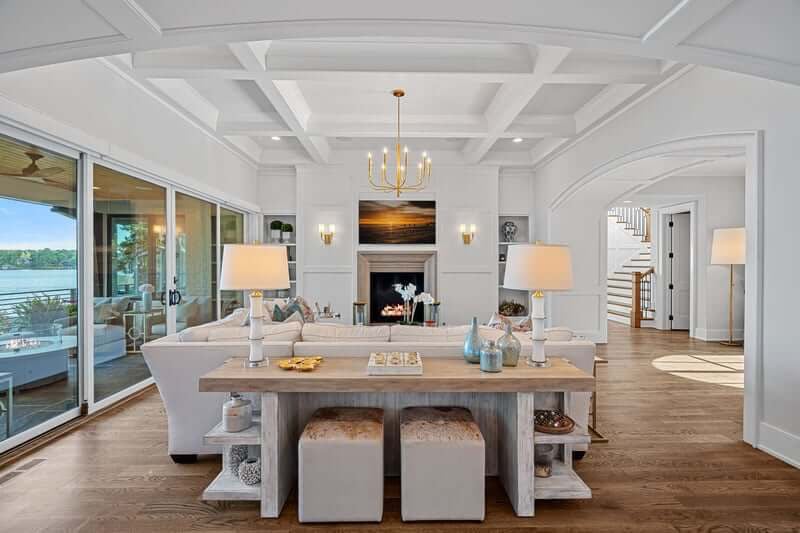
A client called me last spring, a little frustrated. She’d just poured roughly $100,000+ into a stunning kitchen in her Cornelius home—imported tile, a range that could probably cook for a small restaurant—and she wanted to know if it would “all come back” when she eventually sold. I gave her the honest answer I give everyone: some of it, yes. The rest? She’d built that kitchen for herself, and that’s a perfectly good reason to do it—just not the same thing as building it for resale.
That conversation comes up constantly. Whether you’re in a townhome in Davidson or a waterfront estate out toward The Point, every dollar you put into your property is really two questions wearing one coat: Will I enjoy this, and will it pay me back? After nearly two decades of walking buyers through homes all around the lake—and listening to exactly what makes them open or close their wallets—I’ve got a pretty clear picture of which upgrades move the needle here and which ones quietly don’t.
So let’s talk about it. Below are the renovations that consistently earn their keep in the Lake Norman area, ranked loosely from “easiest win” to “biggest swing,” plus the single most expensive mistake I watch homeowners make. Grab your coffee. This one’s worth reading before you call a contractor.
1. Start With the Garage Door (Yes, Really)
It’s the least glamorous upgrade on this list and, dollar for dollar, the smartest.
For six of the last seven years, garage door replacement has topped the national Cost vs. Value report for return on investment. In the most recent report it recouped around 228% of its cost across our South Atlantic region—meaning a roughly $4,000 door can add close to $9,000 in perceived value at sale. Read that again: it more than pays for itself.
The reason is simple geometry. On most homes around here, the garage takes up a third or more of what you see from the street. A dented, builder-grade door drags down the whole first impression; a clean, modern carriage-style door makes the entire facade look ten years younger. Buyers form an opinion before they’re even out of the car.
I’ve watched it happen in my own showings—a buyer’s whole posture changes between the curb and the front step based on what they just drove up to. If a full replacement isn’t in the budget this season, a fresh coat of paint and some decorative hardware buys you most of the impression for a fraction of the cost.
Plan on roughly $1,500 to $4,500 installed depending on size, material, and insulation—and yes, insulation matters here, both for our July heat and for the garage that’s quietly become a home gym. If you’re weighing whether it’s worth doing before you list, that’s exactly the kind of question I’m happy to walk through with you.
2. The Front Door Is Your Handshake
Second only to the garage door for return—and the first thing a buyer actually touches.
A new steel or fiberglass entry door returns somewhere in the neighborhood of 190% to 215% nationally, putting it right behind the garage on the value chart. Add glass inserts or sidelights and you can transform a dim, dated entry into a bright, welcoming one.
The front door is the literal moment of arrival. While I’m fumbling with the lockbox, the buyer is standing there for thirty full seconds with nothing to do but study the door, the hardware, the porch light, the paint. A scuffed slab with a tired brass knob whispers that the rest of the house has been neglected too—fair or not.
My favorite low-cost version of this: a fresh, confident color and new matte-black hardware. I’ve seen a $300 Saturday afternoon make a Mooresville ranch look like a completely different property in the listing photos.
A quality fiberglass door runs roughly $1,500 to $3,500 installed and shrugs off our humidity far better than wood. If you’re not replacing it, at minimum repaint, swap the hardware, and make sure the doorbell and porch light actually work. Small things. Big signal.
3. Landscaping: Follow the “Haircut” Rule
Not a redesign—a trim.
I’m not talking about ripping out the yard for a waterfall feature. I mean fresh mulch, trimmed hedges, a few seasonal flowers by the walk, and a good power-wash of the driveway and walkways. Inexpensive, fast, and one of the highest-impact things you can do before a single photo is taken.
Think of it as a haircut for your home. The plants are there to frame the house, not swallow it. Overgrown shrubs that climb past the windowsills make a home feel dark and smaller than it is—and around the lake, where so many of our lots are beautifully wooded, that overgrowth creeps up faster than people realize.
Here’s the lake-specific version: do not let your landscaping hide your best asset. If you’ve got a water view, I want it visible the moment a buyer steps onto the porch. I’ve walked a seller’s property with pruning shears in mind, pointing at the three branches standing between them and a six-figure view.
A weekend of cleanup costs you mulch and sweat; a light professional refresh might run a few hundred dollars. Either way, it’s the cheapest “renovation” with the most visible return. Curb appeal isn’t fluff out here—it’s a big part of why homes on the right street command a premium.
4. The Kitchen: Refine, Don’t Rebuild
The heart of the home—and the room buyers and appraisers both judge hardest.
Ask any appraiser and they’ll tell you the kitchen drives somewhere around 10% to 15% of a home’s perceived value. But here’s the part homeowners get wrong: you rarely need to gut it. A minor, cosmetic kitchen refresh returns far more of its cost than a full luxury remodel—think painted or refaced cabinets, updated hardware, quartz counters, modern lighting, and a cohesive, matching appliance package.
Buyers read a tired kitchen as a giant future expense and deduct accordingly—often far more than it would actually cost to fix. A clean, current kitchen erases that fear. And note the word matching: a fridge, range, and dishwasher in three different finishes quietly cheapen an otherwise lovely space.
Please—resist stealing square footage from the dining room to build the dream island. I’ve watched buyers walk into a gorgeous oversized kitchen, glance at the now-cramped dining area, and mentally file the whole layout under “weird flow.” On the lake, where we entertain, that functional dining space matters.
A cosmetic refresh might run $10,000 to $25,000 and recoup most of it; a high-end gut renovation can easily top $80,000 and return well under half. The right level of kitchen for your home depends entirely on your neighborhood and price range—more on that crucial point at the end.
5. Make the Primary Bath Feel Like a Spa, Not a Cave
Right behind the kitchen on every buyer’s inspection list.
Buyers consistently tell me they want the primary bath to feel like a retreat—dual vanities, a clean modern mirror, updated fixtures, and tile that’s spotless with fresh, crack-free grout. A mid-range bathroom refresh nationally returns around 70% to 80% of its cost.
That number is lower than the garage door, and I’ll be candid about that. But bathrooms do something the spreadsheet misses: they help a home sell faster and seal the emotional yes. And the single biggest mistake I see costs nothing to fix—heavy, dark window treatments that turn the room into a cave. Take them down and let the light pour in.
Buyers are not, I promise you, worried about someone peeping through a second-story bathroom window in a wooded Davidson cul-de-sac. They’re worried about whether the room feels fresh and bright. Natural light wins that argument every time.
A refresh—new vanity, faucets, mirror, lighting, recaulked tile—often lands in the $5,000 to $15,000 range. If your layout allows, adding a half bath is one of the better value moves in an older home. And if your grout is the only sin, a deep clean and re-caulk is a nearly free upgrade.
6. Floors That Flow
Nothing dates a home faster than tired carpet and five different floors on one level.
Consistent flooring throughout the main level instantly makes a home feel larger and more cohesive. If there’s hardwood hiding under old carpet, refinish it—that’s pure gold. If not, luxury vinyl plank (LVP) has become the smart-money standard: it reads like wood, it’s waterproof, it’s durable, and it costs a fraction of the real thing.
When a buyer walks from tile to wood to carpet to laminate in twenty steps, the eye chops the house into pieces and it feels smaller and choppier than it is. One consistent floor lets the whole space breathe.
Waterproof matters more than usual out here. Between lake days, wet dogs, and back doors that stay open all summer, LVP earns its keep in a lake home in a way it might not somewhere drier.
LVP runs roughly $3 to $7 per square foot installed; refinishing existing hardwood is often cheaper than replacing it and worth every penny. Not in the budget before listing? Hire a real professional to steam-clean the carpets—not the rental machine from the grocery store. It buys you time and a far better first impression.
7. Let the Light—and the Lake—In
The upgrade you can’t buy in a box, but absolutely can enhance.
Light is the first thing buyers feel and the last thing they forget. You can’t manufacture sunshine, but you can stop blocking it: take down heavy treatments, swap dark blinds for something airy, clean the windows until they disappear, and where it makes sense, add or enlarge a window to capture a view.
A smaller home flooded with light feels bigger and happier than a large home that’s dim. Every buyer who walks in is unconsciously asking the same question—how do I feel standing here?—and light answers it before anyone says a word.
This is where lake homes have an unfair advantage, so use it. If you’ve got morning sun coming off the water, I want that room staged to show it off. Capitalizing on a water view with the right window can genuinely change how a home appraises and how fast it sells.
Removing dated window treatments costs nothing. New windows are a bigger investment (and overlap nicely with the energy-efficiency point below), but on a water-view wall, that’s often money well spent. When I tour a listing, the first note I jot down is almost always about the light.
8. Outdoor Living Is Real Square Footage
Around here, the backyard—and the dock—are part of the house.
A deck or stone patio effectively adds a room without the cost of a roof and four walls. Wood decks return roughly 90% to 95% of their cost nationally; composite, around 85% to 90%. Add a screened porch—nearly essential for our mosquito-and-humidity summers—and you’ve created living space people actually use most of the year.
Since 2020, outdoor living has gone from nice-to-have to top-of-list, and nowhere is that truer than on Lake Norman, where the whole lifestyle points outside. Buyers picture the cookouts, the morning coffee on the dock, the kids running toward the water. Give them somewhere to picture it.
Got an old gray, splintery deck? Don’t tear it out in a panic. Power-wash it, replace the rotted boards, hit it with a solid stain, string up some lights, and add a couple of chairs. You’ve turned a liability into an experience for a few hundred dollars.
And if you’re waterfront, the dock is a headline feature—keep it clean, safe, and staged. A tidy, inviting dock photographs like a vacation and sells like one too. If you’re wondering how much your outdoor space is really adding, that’s a fun walk-through to do together.
9. Don’t Skip the Unglamorous Stuff
Nobody brags about a new water heater. Buyers and appraisers quietly love them anyway.
Roof, HVAC, water heater, electrical panel, windows, insulation—the systems you never notice until they fail. Appraisers give real, measurable credit for recently updated major systems, and buyers happily pay a premium to avoid inheriting a list of looming expenses. Attic insulation, in particular, is one of the few projects that can recoup north of 100% of its cost.
An appraiser friend of mine put it perfectly: most of his “bonus” value goes to anything that removes fear, uncertainty, and doubt. A roof with ten good years left and an HVAC system that won’t quit in a Carolina August are pure peace of mind—and peace of mind shows up in the offer price.
Our summers are no joke, and HVAC is the first thing buyers test mentally the moment they feel the air inside. A reliable system isn’t a luxury here; it’s table stakes.
These are bigger-ticket items, so prioritize by what’s oldest and closest to failing. If your roof or HVAC is on its last legs, handling it before listing almost always beats negotiating it (badly) during inspection. Energy-efficient touches—a smart thermostat, dual-pane windows, even paid-off solar—read as lower monthly costs, which buyers translate straight into value.
10. Smart Storage and Honest Square Footage
Buyers don’t just see your rooms—they mentally move in.
Storage sells. A walk-in pantry, a closet with a real organization system, a clean and orderly garage—buyers notice every one and reward it. And the holy grail of adding value is converting space you already have: finishing a basement or attic that’s already under roof turns storage into livable, appraisable square footage.
Watch a buyer tour a home and you’ll see them silently placing their furniture, their gear, their stuff. Run out of places to put it and the home starts to feel small no matter the square footage. Finished space within your existing footprint, by contrast, is some of the smartest money you can spend—you’re adding living area without the cost and risk of building outward.
Garages especially matter around the lake, where boats, kayaks, paddleboards, and bikes all need a home. A clean three-car garage isn’t just storage here—it’s lifestyle infrastructure.
The key phrase is existing footprint. Finishing a basement is smart money; bumping an addition out into the yard is expensive, slow, and risky on return. Convert before you construct—and which one makes sense for your home depends, again, on the neighborhood you’re in.
The One Mistake That Quietly Erases Your ROI
You can do everything on this list right and still lose money on this last one.
The single most expensive error I see is over-improving for the neighborhood. You watch the design shows, fall for the imported marble and the gold fixtures, and pour money into a home until it “should” be worth far more than anything around it. The problem? It won’t appraise, because the comparable sales—the comps—don’t support it.
I think of a homeowner who added a beautiful two-bedroom guest suite to a property in a neighborhood where homes topped out around $750,000. The addition was lovely and genuinely useful for their family. But at sale, there was simply no buyer shopping that street for a million-dollar home, and no comps to back the price. Even a sympathetic appraiser can’t conjure value from thin air—and a lender’s underwriter would flag it if one tried.
You want to own the nicest home on the block. You do not want to be the castle surrounded by cottages. This matters enormously around Lake Norman, where price ranges swing dramatically from one cove or community to the next. A renovation that’s perfectly calibrated in The Peninsula could be a money-loser two neighborhoods over.
Before any major project, look hard at what’s actually selling near you—or ask me to pull the comps. Matching your upgrades to your market is the whole difference between an investment and an expensive gift to the next owner.
The Bottom Line
Here’s the thread running through all of this: the best renovations aren’t the flashiest—they’re the ones that fit your home, your neighborhood, and the way people actually live around this lake. Start outside, where buyers form their first impression. Refine instead of rebuild on the inside. Take care of the unglamorous systems. And never get ahead of your comps.
If you’re weighing a project before you sell—or you just want to know what your home is worth as it stands today—I’d love to help. Reach out anytime, or start with a free home valuation. After almost twenty years on this lake, there’s nothing I enjoy more than helping my neighbors make a smart, confident move. Let’s talk.